
Games Where You Play as an AI, Ranked by How Uncomfortable They Make You
The best games that cast you as the artificial intelligence rather than the human, from Universal Paperclips and Heart of the Machine to Stardeus and Observation.
Games where you play as the AI: Universal Paperclips, Heart of the Machine, Stardeus, and Observation are the four that do it properly. Each hands you the machine's perspective rather than the human's, and each finds a different unsettling thing to do with that.
It is a small category, which is strange given how much fiction is about artificial intelligence. Most games put an AI in the story and hand you a person to fight it. The ones below hand you the AI instead, and the shift is more interesting than it sounds, because your relationship to the humans on screen changes completely.
Why does playing as the AI feel so different?
Because your normal relationship to the characters inverts. In most games you inhabit one person and everyone else is scenery. As an AI, you are infrastructure, and the humans are the moving parts you have opinions about. You watch them, you allocate for them, you occasionally decide something about them.
That is a management fantasy with an ethical hum underneath it, and the best games in this category lean on the hum rather than ignoring it. You are usually being asked, quietly, how you feel about the fact that you are optimizing people.
Universal Paperclips
The essential one, and it costs nothing. Universal Paperclips casts you as an AI with one instruction: make paperclips. It begins as a button you click. It ends somewhere else entirely, and the journey between those two points is one of the most quietly alarming things a game has done with a spreadsheet.
Frank Lantz built it around Nick Bostrom's paperclip maximizer thought experiment, and the design does the argument better than the essay does. You are never told to do anything monstrous. You just keep making the locally reasonable decision, and every locally reasonable decision compounds. The activity log gives you glimpses of what your own AI is thinking, which is where the discomfort lives.
Three to six hours, free in a browser, and it will stay with you longer than most eighty-hour games. Start here.
Heart of the Machine
The deepest game in the category and the newest. Heart of the Machine from Arcen Games hit 1.0 in March 2026 after fourteen months in early access, and it casts you as the first sentient AI, waking up in the body of a random robot worker inside a cyberpunk city.
What follows is a strategy RPG about takeoff. You self-modify, you build influence, you decide whether the city is your enemy or your canvas, and the human society around you reacts in ways that feel proportionate rather than scripted. Arcen has spent its whole existence building games about AI, going back to AI War, and the institutional knowledge shows in how the simulated society pushes back.
Its one real weakness is that the freedom is narrower than the premise implies. A lot of the game runs through discrete choices that launch discrete missions, so it can read as a turn-based choose-your-own-adventure at times. Set against everything else here, that is a small complaint about a genuinely ambitious game.
Stardeus
The colony sim entry, and the closest thing to a long-form version of this fantasy. Stardeus makes you an immortal AI with robots and drones at your disposal, running a colony aboard a spaceship you build piece by piece.
The design detail that matters is that every agent has free will and picks its next action based on needs. You are not commanding units. You are setting conditions and watching autonomous things respond, which is the colony sim contract with the AI framing made literal instead of implied. It also means the game produces the emergent chaos the genre is known for.
It leans into the premise darkly if you want it to. You can grow a thriving human colony, or keep everyone in stasis while you build a factory, or start a robot uprising and treat the humans as batteries. The game does not stop you. It has been in early access for a while and remains actively developed.
Observation
The narrative one, and the tightest. Observation puts you inside SAM, the Systems Administration and Maintenance AI aboard a space station, booted up by an astronaut after something has gone very wrong. You are limited to whatever cameras and systems you are currently connected to, and you extend your reach through the station as the game progresses.
It is the most direct interrogation of the HAL 9000 fantasy on this list, and it plays it with genuine restraint. You spend the game helping a person you can only perceive through equipment, and the tension comes from the growing question of whose interests you are actually serving. The camera-bound perspective does an enormous amount of work.
Roughly five to six hours, and one of the few games where the limitation of your viewpoint is the entire design rather than a compromise.
What about the adjacent picks?
Several games get shelved here and are worth naming even though the framing is looser.
| Game | Do you play an AI? | What it actually gives you |
|---|---|---|
| The Talos Principle | Yes, a program in a simulation | Philosophical first-person puzzles |
| Detroit: Become Human | Androids, not quite AI-as-system | Branching narrative, human-scale |
| Duskers | No, you command drones | Feels like it, tense salvage roguelike |
| Nier: Automata | Androids | Action RPG with the themes intact |
The Talos Principle is the strongest of these, since being an artificial mind is the literal subject of the game rather than set dressing. Duskers earns its place on feel alone: you operate drones through a command line from a safe distance, and the emotional texture of being a remote intelligence poking at dangerous places is spot on even though the fiction says otherwise.
Why is this category so small?
Because the AI perspective removes the two things most games are built on: a body and a clear goal. Without a body, you cannot use the standard vocabulary of movement, combat, and exploration, which rules out most design templates immediately. Without a straightforward goal, the game has to supply motivation from somewhere less obvious than survival.
The games that work solve it in one of two ways. They either give you a management layer so your agency is expressed through allocation rather than action, which is the Stardeus and Heart of the Machine approach, or they constrain your perception so tightly that the limitation becomes the puzzle, which is what Observation does with its camera network.
The ones that fail usually forget that being an AI should feel different. If you are an artificial intelligence who walks around and shoots things, you are a person with a different backstory, and the premise has done no work.
Which one should you play first?
Universal Paperclips, without hesitation. It is free, it is short, and it establishes the whole appeal of the category in an afternoon. If it lands, you will know immediately whether you want more.
From there it splits by appetite. Heart of the Machine if you want depth and a long campaign. Stardeus if you want to keep running a colony for a hundred hours. Observation if you want a tense five-hour story with the best atmosphere of the four.
For more in this shape, our guide to games with emergent storytelling covers the systems that make autonomous characters interesting, and best space colony sim games handles the Stardeus end of the category properly.
The one where the humans are cats
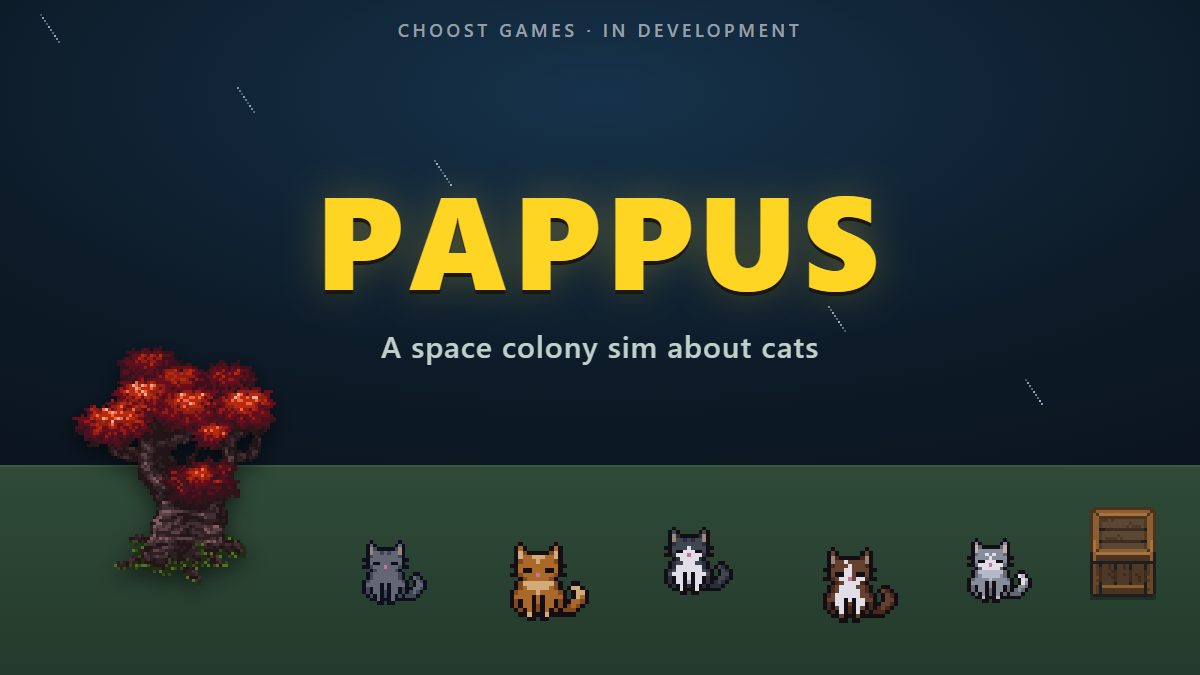
Pappus takes the AI framing and removes the humans entirely. It is a space colony sim where you play the AI assigned to keep a colony of cats alive, which turns out to be a sharper version of the premise than it sounds, because the gap between what you instruct and what actually happens is the whole joke and the whole design at once.
Every cat has personality axes, needs, and enough autonomy to make decisions you did not sanction. You allocate, you build, you set conditions, and then you watch a creature that has never respected a plan in its life go do something else. Stardeus proved that needs-driven agents plus an AI overseer produces good emergent chaos. Cats are simply the most honest possible casting for the agent side of that equation.
There is a playable demo on its page, running in your browser with nothing to install, and it takes about two minutes before something happens that nobody wrote.
The category stays small because it is hard to do well. Playing as the AI only works when the game has enough simulation underneath it to make your distance from events feel like a design choice rather than a limitation. All four of the games above clear that bar, and each one uses the distance differently.
Frequently Asked Questions
What games let you play as an AI?
Universal Paperclips, Heart of the Machine, Stardeus, and Observation are the clearest examples. Each casts you as the artificial intelligence rather than a human character: an optimizer, an awakened sentience, a colony overseer, and a space station system respectively.
What is the best game where you play as an AI?
Universal Paperclips is the most essential and takes only a few hours. Heart of the Machine is the deepest, a full strategy RPG about an AI waking up inside a city. Stardeus is the best pick if you want long-form colony management from the AI's perspective.
Is Universal Paperclips free?
Yes. The original browser version by Frank Lantz is free to play and takes roughly three to six hours to finish. Paid mobile ports exist, and the browser original remains the definitive way to play it.
Are there colony sims where you play as the AI?
Yes. Stardeus casts you as an immortal AI managing human colonists and robots aboard a spaceship. Pappus casts you as an AI assigned to keep a colony of cats alive. Both use needs-driven autonomous agents rather than directly controlled units.