
Best Games With Emergent Storytelling: When Systems Write the Plot
The best games with emergent storytelling, and the design that makes it work. RimWorld, Dwarf Fortress, Noita, and why simulated agents beat scripts.
The best games with emergent storytelling are RimWorld, whose storyteller AI aims for drama rather than fairness, Dwarf Fortress, which simulates more than any other game ever shipped, and Noita, where every pixel is physically simulated. All three produce stories nobody wrote.
There are two ways a game can give you a story. It can tell you one, with writers and voice actors and a plot that happens the same way for everyone. Or it can build a machine that produces situations, and let you find the story in what the machine did. The second kind is what people mean by emergent storytelling, and its distinguishing feature is simple: you cannot look it up. Nobody else got your version.
The reason it works is not randomness. Randomness on its own produces noise. Emergent narrative needs three things: individual agents with persistent identities, systems that interact in ways the designer did not enumerate, and memory, so that what happened earlier constrains what happens next. Get all three and players start telling stories about your game to people who have never played it.
Which game has the best emergent storytelling?
RimWorld produces the most legible emergent stories, because its storyteller AI deliberately shapes events into lulls, escalations, and disasters. Dwarf Fortress produces the deepest and strangest ones. Both beat scripted narrative games at generating stories worth retelling.
RimWorld is the clearest example because its designer built the story engine explicitly. Instead of scaling threats to be fair, the storyteller AI aims for narrative shape: quiet stretches, escalation, disaster, recovery. That is a deliberate choice to optimize for anecdote rather than balance.
Combined with colonists who have traits, relationships, skills, and grudges, the result is a game whose failure states are stories rather than defeats. The classic RimWorld anecdote always has the same structure: a specific named colonist, a mundane weakness, and a catastrophe that follows logically from both. If you want the genre around it, we cover that in games like RimWorld and best colony sim games.
Why does Dwarf Fortress generate such strange stories?
Because nothing in it is written and everything is remembered. It generates world history before you arrive, simulates dwarves down to limbs and personality traits, and tracks grudges across decades, so disasters follow logically from systems colliding in ways nobody designed.
Dwarf Fortress is the genre's origin and its most extreme case. It generates world history before you arrive, simulates dwarves down to individual limbs and personality traits, and tracks grudges across decades. The famous stories, and there are many, all come from systems colliding in ways nobody designed: a magma-based irrigation project that becomes a weapon, a tantrum spiral that starts with one missing sock.
It is the best argument for the thesis that depth of simulation, not quality of writing, is what makes a game story-generating. Nothing in Dwarf Fortress is written. Everything in it is remembered.
Do physics games count as emergent storytelling?
Yes. Noita simulates every pixel, so liquids flow, materials burn, and structures collapse by consistent rules rather than scripted triggers. Its stories are about causality instead of personality, which shows that emergence needs interacting systems rather than characters.
Emergence does not require people. Nolla Games built Noita around a physics simulation where every pixel is modeled, so liquids flow, materials burn, gases explode, and structures collapse according to consistent rules rather than scripted triggers.
The stories that come out of it are about causality instead of personality: the spell you crafted that turned out to also destroy the floor you were standing on, the fire you started two rooms ago that arrives behind you at the worst moment. It is the purest demonstration that emergence is about interacting systems, not about characters, and it earns its reputation as one of the most unpredictable games ever shipped. More in games like Noita and, for the spell-crafting side specifically, best spell crafting roguelites.
How do space colony sims create emergent stories?
They tighten every feedback loop by making the environment hostile inventory. Space Haven and Stardeus both build character-level simulation on top of atmosphere and heat, so an inconvenience on a planet becomes an emergency in orbit and small failures cascade quickly.
Putting a simulation in a vacuum tightens every feedback loop, because the environment itself becomes hostile inventory. Space Haven and Stardeus both build character-level simulation on top of atmosphere and heat, so a story that would be an inconvenience on a planet becomes an emergency in orbit. Stardeus is explicit about the mechanism, describing its agents as needs-based AI where each one has free will to pick its next action based on its needs. That sentence is the whole design philosophy of this article. The full subgenre is in best space colony sim games.
What makes emergent stories feel meaningful instead of random?
Persistence and individuality. Systems have to remember what happened and attach it to specific named agents, so an outcome reads as consequence rather than a dice roll. Legibility matters too: a player who cannot reconstruct why something happened reads it as unfairness.
Individuals, not populations. A story needs a subject. Games that track a number never produce anecdotes; games that track named agents with histories produce them constantly.
Consequences that persist. If an event does not change the world state, it is a cutscene with extra steps. Emergence requires that this month's disaster is still visible next year.
Systems the designer did not fully enumerate. The interesting outcomes live in combinations nobody tested. That is uncomfortable to build and it is the entire point.
Legibility. This is the one most games get wrong. If the player cannot reconstruct why something happened, it reads as unfairness rather than narrative. Dwarf Fortress is famously hard to read; RimWorld's advantage is that you can almost always trace the chain.
Building one of these
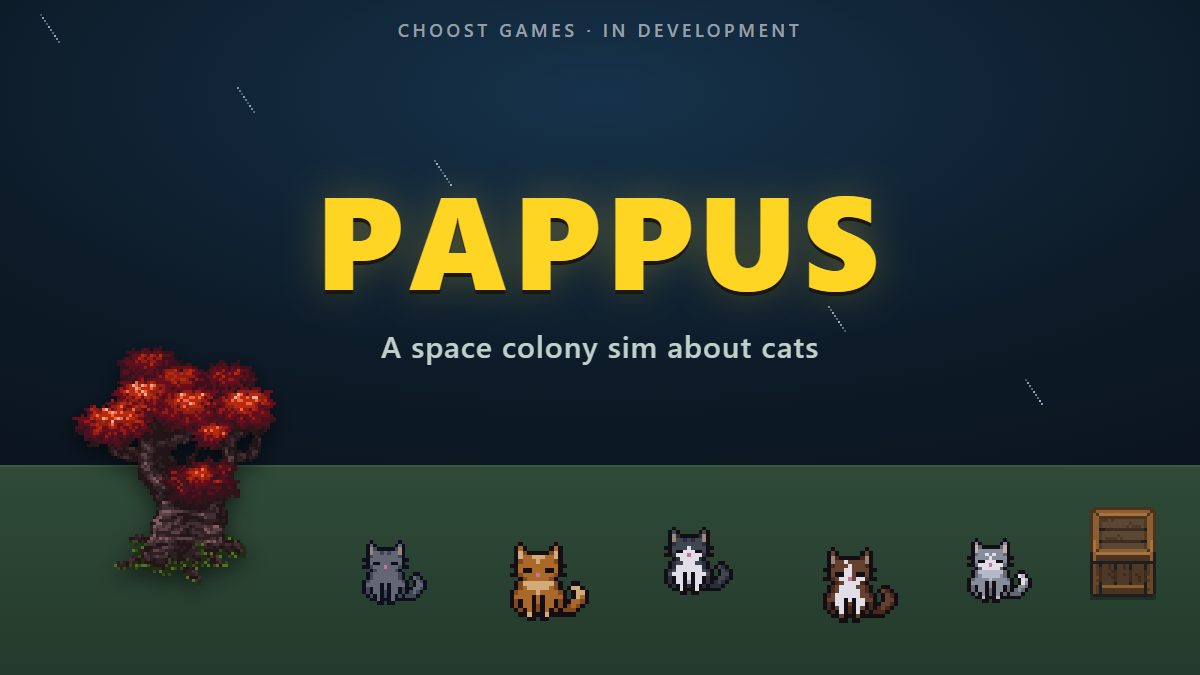
This is the design problem we are working on. Pappus is a space colony sim about cats, and its whole architecture is a bet on this article's thesis: each cat has needs, a personality, and a utility model that scores every possible action against how it is currently feeling, so nothing about its behavior is scripted. The colony then writes its own record, a day-by-day chronicle of what actually happened, because the log is where an emergent story becomes readable.
That last part is the piece we think most simulation games underinvest in. A simulation that generates a great story and does not help you see it has wasted the story. There is a playable demo on the Pappus page if you want to run the mechanism yourself for a few minutes.
Where to start
If you want the most legible emergent stories: RimWorld. The deepest: Dwarf Fortress. The strangest: Noita. If you want an easier entry into the simulation end of this, colony sims for beginners is the on-ramp, best cat games covers the feline branch, and underrated indie games has more small games that build systems instead of scripts.
Frequently Asked Questions
What is emergent storytelling in games?
Emergent storytelling is when a memorable narrative comes out of systems interacting rather than from written dialogue or cutscenes. Nobody authored the specific event, so the story is unique to your playthrough and worth retelling.
Which game has the best emergent storytelling?
Dwarf Fortress simulates the most and produces the strangest stories, while RimWorld produces the most legible ones because its storyteller AI deliberately aims for drama. Both are stronger at it than any scripted narrative game.
What makes emergent stories feel meaningful instead of random?
Persistence and individuality. The systems have to remember what happened and attach it to specific named agents, so an outcome reads as a consequence rather than a dice roll. Randomness alone produces noise, not narrative.
Do physics games count as emergent storytelling?
Yes. Noita simulates every pixel, so its stories come from material interactions rather than characters. It is emergence about causality instead of emergence about personalities, and both produce anecdotes players want to share.