
RimWorld vs Dwarf Fortress: Which One Should Eat Your Next Six Months
RimWorld is the accessible one with the storyteller and the mods. Dwarf Fortress is the deeper one with the free version and the brutal interface. Here is which one fits you.
Play RimWorld first. It teaches you the genre with a usable interface and clicks in five to ten hours. Dwarf Fortress is deeper by a distance that is hard to overstate, and it rewards people who already speak colony sim. That is the short answer, and if you stop reading here you will make the right choice.
The long answer is that these games are less similar than their shelf placement suggests, and picking between them is really picking between two philosophies about what a simulation is for.
What is the core difference between RimWorld and Dwarf Fortress?
RimWorld is a story machine. Dwarf Fortress is a world machine. RimWorld runs an AI storyteller that watches your colony's prosperity and deliberately paces disasters against it, so the game is always shaping a narrative arc. Dwarf Fortress generates a world with centuries of history and simulates it honestly, and your fortress is one small thing happening inside a system that does not care about your arc.
That difference produces everything else. RimWorld's events feel authored because they are. Dwarf Fortress's events feel geological because they are.
How do they compare feature by feature?
| RimWorld | Dwarf Fortress | |
|---|---|---|
| Setting | Sci-fi frontier | Fantasy, generated world with history |
| Map | Single flat map | Full Z-levels, dig up and down |
| Event source | AI storyteller pacing difficulty | Pure simulation, no director |
| Combat | Direct control, drafted pawns, RTS-like | Hands-off, resolved by simulation |
| Interface | Clean, mouse-driven | Demanding even after the Steam pass |
| Learning curve | 5 to 10 hours | Weeks |
| Mods | Enormous Steam Workshop library | Substantial, mostly outside Steam |
| Price | About $35 base, near $150 with all five DLC | Free classic version, about $30 on Steam |
The Z-level row is the one people underrate. RimWorld happens on a single plane, and once you have internalized that, base design becomes a two-dimensional puzzle you can get genuinely good at. Dwarf Fortress lets you dig down through rock layers for as long as your nerve holds, which turns base design into architecture and occasionally into flooding an entire fortress by accident.
Which one is easier to learn?
RimWorld, by a wide margin, and the gap is mostly interface rather than concept. RimWorld gives you a tutorial, readable menus, and a mouse that does what you expect. Most players report the systems feeling natural somewhere between five and ten hours, which is fast for a genre this deep.
Dwarf Fortress got a graphical Steam release in December 2022 that added tilesets, mouse support, and a soundtrack, and it is meaningfully more approachable than the ASCII original. It is still demanding. The menus are dense, the wiki is load-bearing, and a substantial part of early play is reading about how weapons work rather than using them. Long-time players will tell you that is part of the appeal, and they are being sincere.
If either sounds like too much, our colony sims for beginners guide has gentler on-ramps that teach the same fundamentals.
Which one has better combat?
RimWorld, if you want to participate. You can draft colonists mid-fight, order specific targets, pick firing positions, and treat a raid as a small real-time tactics encounter. Raids are frequently the tensest part of a session precisely because you have your hands on the controls.
Dwarf Fortress has the more detailed combat model and gives you less to do with it. You can position military squads and set orders, but once the fighting starts, resolution happens in the simulation using material properties, body part damage, skill, and equipment. You read the combat log afterward to find out that a goblin's arm was severed at the elbow by a copper axe. It reads like a coroner's report, which some people love and others find alienating.
Which one generates better stories?
This is the closest call in the comparison. RimWorld produces stories with better pacing because the storyteller is engineering pacing on purpose, and its characters have richer social modeling, so drama tends to land on individuals you know.
Dwarf Fortress produces stories with more surprise because nothing is being paced. The world has its own history, creatures have their own motivations, and consequences chain through systems nobody tuned for narrative effect. The genre's most legendary anecdotes overwhelmingly come from Dwarf Fortress, and that is not an accident.
If emergent narrative is specifically what you are chasing, our guide to games with emergent storytelling covers what makes it work across the whole category.
What about mods?
RimWorld wins this outright, and it is a bigger factor than the comparison usually gets credit for. The Steam Workshop holds many thousands of RimWorld mods with one-click installation, ranging from quality-of-life fixes to total conversions that rebuild the game around medieval combat or entirely different settings. Players reporting thousands of hours are almost always describing a modded game.
Dwarf Fortress has a real modding scene with serious technical depth, since the raw files expose an enormous amount of the simulation. It is smaller, less centralised, and historically lived outside Steam, which means more manual installation and more reading. The tooling gap is closing but has not closed.
If your intention is to play one game for years, RimWorld's mod ecosystem is the strongest argument in its favour, and Ludeon's own FAQ is candid about how central modding is to the game's design.
Which one is the better value?
Dwarf Fortress, on paper, since the classic version is free and always has been, and the Steam version runs about $30 for something with functionally unlimited depth.
RimWorld's pricing is the standing complaint in its community. The base game is around $35, and there are now five expansions: Royalty in 2020 and Ideology in 2021 at $19.99 each, then Biotech in 2022, Anomaly in 2024, and Odyssey in 2025 at $24.99 each. Buying everything approaches $150, which is a lot for an indie game.
The mitigating fact is that the base game is complete on its own and holds an overwhelmingly positive Steam rating without any of the DLC. The expansions add systems rather than fixing gaps. Most veterans will tell a newcomer to buy the base game, play a hundred hours, and then decide which expansions match how they actually play.
So which should you buy?
Buy RimWorld if you want characters you care about, a readable interface, an enormous mod library, and combat you get to fight. It is the better first colony sim and probably the better game for most people, full stop.
Buy Dwarf Fortress if you want depth with no ceiling, a world that exists independently of you, verticality, and stories that surprise their own developers. Download the free classic version first and find out how you feel about it before spending anything.
Buy both eventually. They scratch adjacent itches and the veterans who have logged thousands of hours in each are unanimous that the comparison is a false choice. For the wider field, our best colony sim games roundup covers what sits around these two, and games like RimWorld handles the direct alternatives.
A third option with considerably more fur
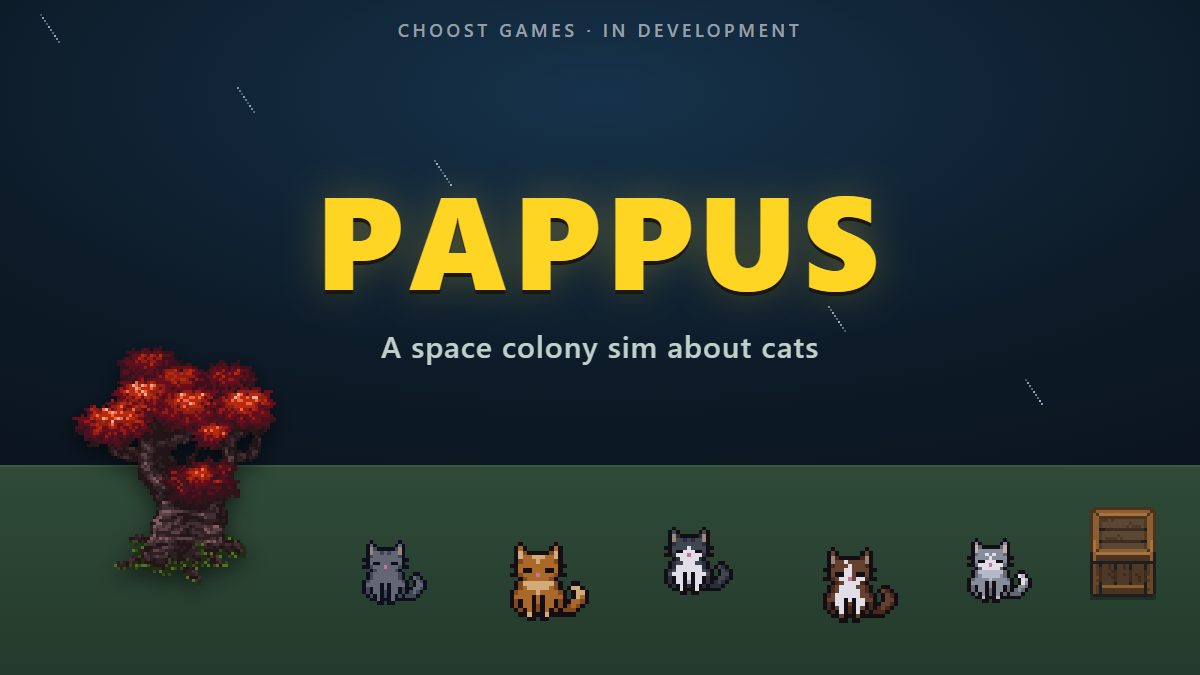
If both of these look appealing but you want something smaller and stranger to run alongside them, Pappus takes the RimWorld side of this argument and pushes it. It is a space colony sim where the colonists are cats and you play the AI assigned to keep them alive, so the character-drama end of the genre is the whole design rather than one system among many.
The cats have individual personalities, needs, and enough autonomy to ignore you, which produces the same category of story RimWorld is built to generate, with the comic advantage that nobody expects a cat to cooperate. There is a playable demo on its page that runs in your browser, which takes about two minutes to reach the first moment where something goes wrong on its own.
Whichever way you go, the genre pays back the time. Start with RimWorld, keep Dwarf Fortress in your back pocket for when the depth stops being intimidating and starts being the appeal.
Frequently Asked Questions
Should I play RimWorld or Dwarf Fortress first?
Play RimWorld first. It teaches colony sim fundamentals with a workable interface and a tutorial, and it takes five to ten hours to click. Dwarf Fortress rewards players who already understand the genre, and its interface is still demanding even after the Steam release added graphics.
Is Dwarf Fortress deeper than RimWorld?
Yes, substantially. Dwarf Fortress simulates a whole generated world with its own history, full Z-level verticality, fluid mechanics, and material properties down to absurd detail. RimWorld simulates a single flat map and focuses its depth on characters rather than physics.
Is Dwarf Fortress free?
The original classic version is free from Bay 12 Games and always has been. The Steam release, which adds graphics, mouse support, and music, is a paid version at roughly $30. Both are the same underlying game.
How much does RimWorld cost with all DLC?
The base game runs around $35, with five expansions: Royalty and Ideology at $19.99 each, and Biotech, Anomaly, and Odyssey at $24.99 each. Buying everything lands near $150. The base game is complete on its own and most players start there.