
Colony Sim vs City Builder: Which One Are You Actually In the Mood For
Colony sims give you a handful of named survivors and personal disasters. City builders give you thousands of anonymous residents and infrastructure problems. Here is how to tell which one you want.
A city builder gives you thousands of anonymous residents and asks you to solve infrastructure. A colony sim gives you eight named people and asks you to keep them alive. Both are building games with menus and resource counters, which is why they get shelved together, and the difference between them is the difference between traffic modeling and a funeral.
Pick wrong and you will bounce off a genuinely good game for reasons that have nothing to do with quality.
What is the core difference between the two genres?
Scale and intimacy. City builders operate at population scale, where individuals are statistics and your problems are systemic: traffic throughput, zoning balance, service coverage, budget. Colony sims operate at individual scale, where every character has a name, a skill spread, a mood, and a way of dying that you will feel responsible for.
Both belong to the same formal family, construction and management simulation, which is why Steam's tags are close to useless for separating them. The practical test is simple. If you would recognize a resident's name, you are in a colony sim.
How do the two genres differ in practice?
| Colony sim | City builder | |
|---|---|---|
| Population | 5 to 200 named individuals | Thousands, anonymous |
| Control | Indirect, via work priorities | Direct, via placement and policy |
| Core pressure | Survival: food, heat, mood, defense | Efficiency: traffic, budget, services |
| Failure state | Everyone dies | Deficit, decline, ugly commute |
| Story source | Emergent character drama | Player's own planning satisfaction |
| Examples | RimWorld, Dwarf Fortress, Oxygen Not Included | Cities: Skylines, SimCity, Anno |
The row that matters most is control. In a city builder, you place a thing and the thing exists. In a colony sim, you queue a wall and then wait to find out whether anyone feels like building it, because construction is ranked fourth on Gavin's priority list and he has decided that hauling is more pressing.
Which genre has the better stories?
Colony sims, and the gap is wide. City builders produce satisfaction, which is real and worth having, but it belongs to you rather than to the city. You solved the interchange. You look at the interchange. The interchange does not have opinions.
Colony sims produce narrative because they have characters and those characters have interiority modeled in code. Moods, grudges, marriages, phobias, and breakdowns are all simulated variables that interact with the survival systems, so a bad winter becomes a story about a specific person rather than a dip on a graph. Everyone who plays these games has one they tell at parties, badly, at length.
City builders can generate stories, but they usually come from spectacle rather than character. A tornado hit the industrial district. That is an anecdote. A colony sim story has a cast.
Which one is harder?
Colony sims, on average, though the spread inside each genre is bigger than the gap between them. Colony sims stack two difficulties: you have to build competently, and you have to keep fragile autonomous people alive while doing it. There is a real failure state where the run ends and everyone is dead.
City builders rarely kill you. A badly run city gets ugly, congested, and broke, and then you fix it. The pressure is aesthetic and economic rather than existential, which is exactly why people reach for them when they want to build something without being punished for it.
Within the colony sim genre, the range runs from Timberborn, comprehensible in an evening, to Dwarf Fortress, which is a hobby with a learning curve measured in weeks. Our colony sims for beginners guide sorts that out.
Can a game be both?
Yes, and several of the best ones sit deliberately on the seam. Frostpunk gives you a population counter like a city builder and survival pressure like a colony sim, then adds law-making on top. Songs of Syx starts as a colony sim with a dozen settlers and ends as a city builder with thousands, which is genuinely the point of it. Against the Storm has settlement-scale building with roguelite runs wrapped around it.
Timberborn is the cleanest hybrid on the list. It has colony sim survival pressure through droughts and water management, city builder scale in the mid game, and a vertical planning layer that neither parent genre really does. It is also the friendliest entry point in the whole space, which is unusual for a hybrid.
Where do factory games fit into this?
Off to one side, and it is worth naming because Factorio and Satisfactory get recommended to colony sim players constantly. Factory games strip out the people entirely and keep the logistics. Nobody has a mood, nothing starves, and the pressure comes from throughput rather than survival.
That makes them the purest optimisation experience of the three categories and the least likely to produce a story. If what you liked about a colony sim was designing efficient layouts, factory games give you that with the emotional variable removed. If what you liked was Marla having a breakdown, they will feel empty.
The three-way test is straightforward. People and survival gets you a colony sim. People and infrastructure gets you a city builder. Machines and throughput gets you a factory game. Games that mix two of the three are usually the interesting ones.
Do these genres want different amounts of attention?
Yes, and this is the practical difference people notice most after an hour. Colony sims demand continuous attention because things go wrong in real time and a paused game is often the only way to respond. You are on call.
City builders are far more forgiving of a wandering mind. The city keeps working while you think, and most problems announce themselves slowly through a growing complaint rather than through a fire. That makes them the better genre for a podcast, and colony sims the better genre for an evening where you actually want to be somewhere else in your head.
Which one should you play tonight?
Ask what you want to feel. If you want to solve a puzzle and admire the solution, play a city builder. The satisfaction is architectural and it holds up.
If you want something to go wrong in a way you will remember, play a colony sim. The genre is built to produce disasters with names attached, and the best sessions are the ones where your plan survives contact with a hungry, moody, entirely autonomous cast for about six hours before collapsing spectacularly.
If you are still deciding, our best colony sim games roundup covers the field, and what is a colony sim explains the mechanics underneath the genre in more detail.
Which genre is better for a first building game?
City builders, if you have never played either. The feedback is clearer, the failure is softer, and nothing about the interface assumes you already understand indirect control. You place a road, cars use the road, and the relationship between action and result is legible from minute one.
Colony sims ask you to accept that your instructions are suggestions before they teach you anything else, and that is a strange first lesson. The exception is Timberborn, which is gentle enough to work as a first building game in either direction and quietly teaches colony sim habits while feeling like a city builder.
If you already know you want characters rather than infrastructure, skip the on-ramp and go straight to a friendly colony sim. Our what is a colony sim explainer covers the mechanics you will need in the first hour.
The version where the residents are cats
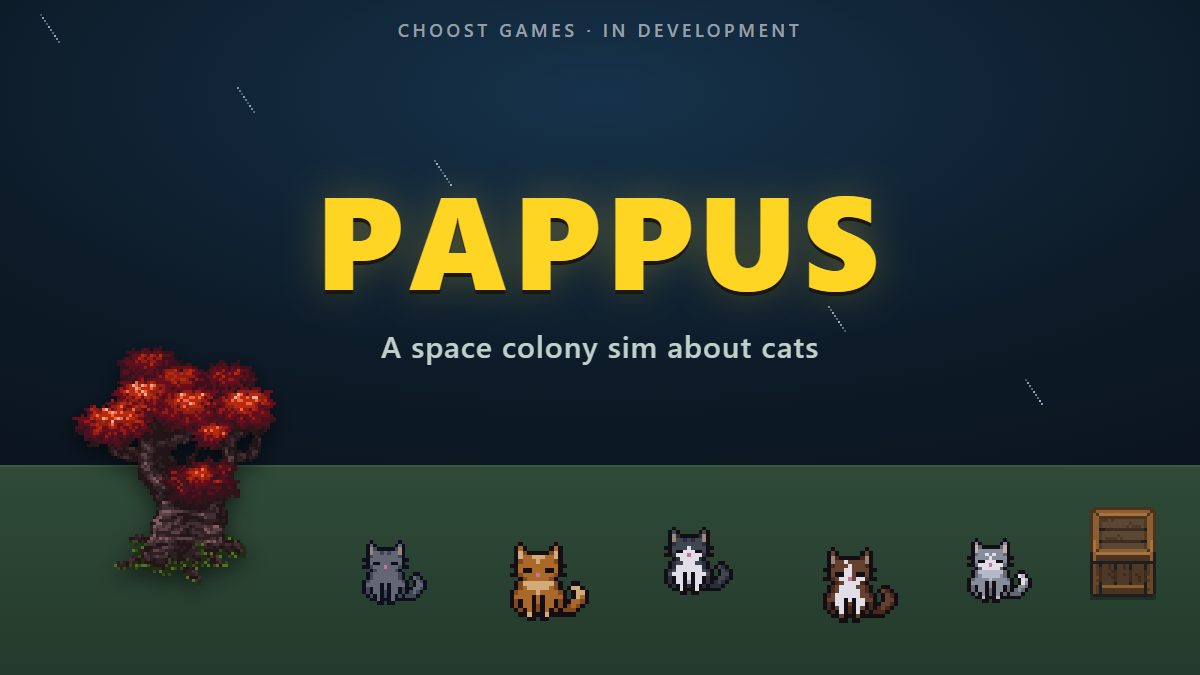
Pappus sits firmly on the colony sim side and pushes the intimacy angle harder than most. It is a space colony sim where the colonists are cats and you play the AI assigned to keep them alive, so the indirect-control problem is baked into the premise rather than layered on top of it. You are already the thing giving instructions to characters who will consider them and then do something else.
That is the design bet: cats are the most honest possible expression of what a colony sim colonist already is, which is an autonomous agent with needs and no particular interest in your plan. There is a playable demo on its page, running in the browser with nothing to install, which is the fastest way to feel the difference between the two genres this article has been describing.
Both genres are worth your time. They just want different things from your evening, and knowing which is which saves you from blaming a good game for being the wrong one.
Frequently Asked Questions
What is the difference between a colony sim and a city builder?
A city builder gives you an anonymous population in the thousands and asks you to solve infrastructure like traffic, zoning, and utilities. A colony sim gives you a handful of named individuals with needs and traits and asks you to keep them alive. City builders scale outward. Colony sims scale inward.
Is RimWorld a city builder?
No. RimWorld is a colony sim. You manage roughly five to twenty named colonists with individual skills, moods, and relationships, and you control them indirectly through work priorities. City builders like Cities: Skylines deal in population totals rather than individuals.
Is Cities: Skylines a colony sim?
No. Cities: Skylines is a city builder. Its residents are statistical rather than individual, its core problems are traffic, zoning, and service coverage, and there is no survival pressure. Both genres are construction and management simulations, which is where the confusion comes from.
Which is harder, a colony sim or a city builder?
Colony sims are generally harder because they add survival failure states and indirect control on top of building. A city builder that goes badly gives you a deficit. A colony sim that goes badly gives you a dead colony. Difficulty varies more within each genre than between them.