
What Is a Colony Sim? The Genre Explained Over One Coffee
A colony sim is a management game where you indirectly guide a small group of autonomous characters through survival pressure. Here is what defines the genre, how it differs from city builders, and where to start.
A colony sim is a management game where you keep a small group of autonomous characters alive through indirect control. You set the priorities and build the base. They decide what to actually do about it. The genre covers RimWorld, Dwarf Fortress, Oxygen Not Included, and a long tail of games about settlements, spaceships, and the specific horror of running out of food in winter.
That definition sounds tidy. Playing one is considerably less tidy, which is the entire appeal.
What actually makes a colony sim a colony sim?
Three things have to be true. The characters are autonomous, so you set work priorities rather than issuing direct orders. The pressure is survival-shaped, so food, heat, power, and mood can all kill you. And the stories are emergent, produced by systems colliding rather than by a writer deciding what happens next.
Miss any one of those and you have a different genre wearing similar clothes. A strategy game where you click a unit and it goes where you clicked is not a colony sim. A survival game where you personally chop the wood is not a colony sim. The distance between your intention and what your colonists actually do is where the whole genre lives.
How does indirect control actually work?
You give your colonists a ranked list of what matters, and they pick their own tasks from it based on skills, needs, and mood. If nobody has hauling set high enough, your steel sits in the rain. If your best doctor is also your best cook, he will be somewhere else the moment somebody bleeds.
This is the part that breaks people coming from real-time strategy. In an RTS, a unit that ignores you is a bug. In a colony sim, a colonist who ignores you is working as designed, and figuring out why is the actual gameplay. Randy went to eat instead of putting out the fire because his hunger crossed a threshold you were not watching. The system is not being coy about it. You just were not reading the right number.
The reward for accepting this is scale. Once your priorities are tuned, twenty colonists run themselves and you get to think about the next problem instead of the current one. The reward for fighting it is a slow afternoon of micromanaging people who have opinions.
What is emergent storytelling, and why does everyone bring it up?
Emergent storytelling means the game has no script, and the memorable moments come from systems interacting in ways the developers never specifically wrote. A raider drops a grenade. The grenade starts a fire. The fire reaches your chemfuel store. Your surgeon panics because of a trait she rolled at world generation, runs the wrong way, and now nobody can operate on the guy bleeding in the hallway.
Nobody wrote that. It assembled itself out of a fire spread model, a mood system, a skill system, and bad luck. Ask anyone with four hundred hours in the genre what happened in their game and you will get a story with a beginning, a middle, and an ending nobody intended. That is the product.
It also explains why colony sims retain players for years while technically superior games get finished and forgotten. A scripted game runs out of script. An emergent one keeps generating new material for as long as you keep operating it.
What are the games that define the genre?
Five titles do most of the defining, and they split cleanly by what they care about.
| Game | Setting | What it optimizes for | Difficulty to learn |
|---|---|---|---|
| RimWorld | Sci-fi frontier | Character drama, mod depth | Moderate |
| Dwarf Fortress | Fantasy | World simulation, absurd depth | Severe |
| Oxygen Not Included | Sealed asteroid | Engineering and thermodynamics | Moderate to hard |
| Timberborn | Post-apocalyptic beavers | Water physics and vertical planning | Gentle |
| Going Medieval | Medieval | Approachable base building | Gentle |
RimWorld is the reference point because it built an AI storyteller that deliberately paces disasters against your prosperity, which turns a simulation into a narrative machine. Dwarf Fortress went the opposite direction and simulates a whole world with its own history, where your fortress is one small thing happening inside it. Oxygen Not Included cares more about heat exchange than feelings and is closer to an engineering puzzle with a pulse.
If you want the full field rather than the shortlist, our guide to the best colony sim games covers the genre properly.
Are colony sims hard to get into?
The honest answer is that the genre's reputation is inherited from its two deepest entries and does not describe most of it. Timberborn and Going Medieval are comprehensible inside a single evening, and you will have a working settlement before you go to bed. RimWorld takes five to ten hours before the systems feel natural, which is why it makes such a good second game rather than a first one.
Dwarf Fortress is the outlier that scared everyone. It is genuinely a multi-week proposition, its interface is still an acquired taste after the Steam release dressed it up, and its community's famous motto about losing being fun is a warning as much as a joke.
Start at the shallow end. The deep end stops being intimidating faster than you expect. Our colony sims for beginners guide sequences this properly if you want the full on-ramp.
What does a typical session actually look like?
You land, you dig or clear a footprint, you get food and shelter running before the first threat arrives, and then you spend the rest of the run fixing whatever the game breaks. The rhythm is stabilise, expand, get punished for expanding, stabilise again at the new size.
Early hours are logistics. Where does the food go, how far do people walk to reach it, what happens when it rains. Middle hours are specialisation, once you have enough colonists that individuals can have jobs rather than doing everything badly. Late hours are usually about defence and about the fact that your base was designed by someone who did not know what they were doing, which was you, eleven hours ago.
The thing veterans do that beginners do not is read the mood tab. Almost every colony that collapses collapses socially first, and the numbers warn you well in advance of anyone setting a fire.
What is the difference between a colony sim and a city builder?
A city builder hands you thousands of anonymous residents and asks you to solve infrastructure. A colony sim hands you eight named people and asks you to keep them alive. Cities: Skylines wants you thinking about traffic throughput. RimWorld wants you thinking about whether Marla is going to have a breakdown because her husband died and she has been sleeping in a barracks.
Both are construction and management simulations in the formal genre sense, and plenty of games straddle the line. The practical test is whether you would recognize a citizen's name. If the game expects you to, it is a colony sim. We go deeper on this in colony sim vs city builder.
How long does a colony sim run take?
Anywhere from two hours to permanent. A short run ends when your first colony dies, which for most people happens somewhere in the first evening and is the correct way to learn.
A committed run in RimWorld or Dwarf Fortress can go for hundreds of hours across one save, because these games have soft endings that almost nobody plays toward. RimWorld technically lets you build a ship and leave. Most players never do, because the interesting part was the colony, and leaving means admitting the story is over.
Why do people sink hundreds of hours into these?
Because the failure is intimate. Losing a city builder means a budget spreadsheet turned red. Losing a colony sim means Grimm starved because you built the freezer on the wrong side of the base and then a solar flare took the cooling out for six days.
You remember the second one. You tell people about the second one. That difference is the whole genre, and it is why a category built on menus and priority tables produces more stories per hour than most narrative games manage on purpose.
A colony sim about cats, and the AI stuck managing them
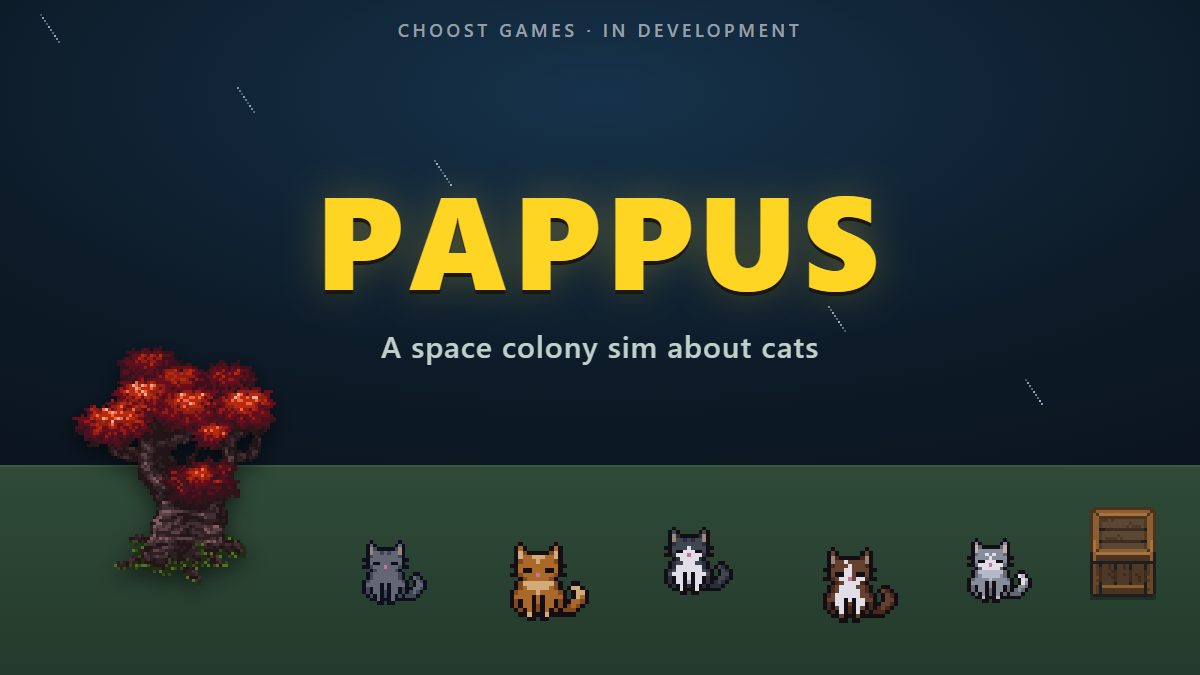
If the premise appeals but the fantasy setting does not, Pappus takes the genre somewhere else. It is a space colony sim where the colonists are cats and you play the AI assigned to keep them alive, which means every design idea above still applies while the characters remain constitutionally uninterested in cooperating with any of it.
The autonomy is the point. Cats have needs, personalities, and enough independence to make decisions you did not authorize, which is exactly the ingredient that makes colony sim stories worth telling. There is a playable demo running in your browser on its page, so you can watch the indirect-control loop do its thing without installing anything.
That is the genre in one sitting. Pick something from the gentle end, run it until something goes wrong, and pay attention to why. The wrongness is the content.
Frequently Asked Questions
What is a colony sim?
A colony sim is a management game where you keep a small group of autonomous characters alive through indirect control. You set priorities, build the base, and manage food, heat, power, and morale, while the characters decide moment to moment what to actually do. RimWorld, Dwarf Fortress, and Oxygen Not Included define the genre.
What is the difference between a colony sim and a city builder?
A city builder gives you an anonymous population measured in thousands and asks you to solve infrastructure. A colony sim gives you a handful of named individuals with needs, traits, and moods, and asks you to keep them alive. City builders scale up. Colony sims scale down and get personal.
Are colony sims hard to learn?
It depends entirely on which one. Going Medieval or Timberborn will make sense inside one evening. RimWorld takes five to ten hours before the systems feel natural. Dwarf Fortress is a genuine multi-week proposition. The genre's fearsome reputation comes almost entirely from its deepest entries.
What is the best colony sim to start with?
RimWorld is the standard recommendation because it teaches genre fundamentals without the interface tax, and it has the largest mod library of any game in the category. If RimWorld looks intimidating, Timberborn and Going Medieval are gentler on-ramps that use the same core ideas.