
Why Your Colonists Ignore You, and Why That Is the Whole Point
Work priorities, needs, and moods explain almost every colonist who wandered off mid-task. Here is how indirect control actually works and how to debug a colony that will not cooperate.
Your colonists ignore you because colony sims use indirect control. You set ranked work priorities, and each colonist picks their own next task based on those priorities, their skills, their current needs, and their mood. The wall you queued does not get built because construction sits below hauling on somebody's list, or nobody can reach the site, or the only qualified builder got hungry twelve seconds ago.
None of that is a bug. It is the mechanic the entire genre is built on, and learning to read it is the difference between fighting a colony sim and playing one.
What is indirect control?
Indirect control means you influence behaviour rather than commanding it. In a real-time strategy game, you click a unit and tell it where to go, and it goes. In a colony sim, you tell the colony what matters and then find out what happens.
The practical form this takes is a priority grid. Each colonist has a ranked list of work types: construction, hauling, cooking, doctoring, mining, cleaning, and so on. When a colonist finishes something and becomes idle, they scan the available jobs and take the highest-ranked one they can actually do and actually reach.
That is the whole system. Almost every mystery in a colony sim resolves to some version of it.
Why does this exist at all?
Because direct control does not scale, and because the gap is where the stories live.
The scaling argument is practical. A colony of twenty people generating tasks continuously would be unplayable under direct control. You would spend the entire game issuing orders and never get to think about anything else. Priorities let you set policy once and let the colony run itself, which is what makes the mid-game possible.
The story argument is the more interesting one. Everyone who has logged serious hours in RimWorld or Dwarf Fortress has an anecdote about a colony collapsing in a way nobody designed, and every one of those anecdotes depends on colonists making their own choices. A raider throws a grenade, the grenade starts a fire, the fire reaches the chemfuel, and the surgeon runs the wrong way because of a trait rolled at world generation. Nobody wrote that. It assembled itself.
Remove indirect control and you remove the engine. Our guide to games with emergent storytelling covers why this particular design decision produces more memorable moments than most scripted narrative does.
What actually determines what a colonist does?
Four inputs, checked roughly in this order.
Needs. Hunger, rest, and comfort override work when they cross a threshold. A colonist who abandons a task mid-way has usually hit one. This is the single most common explanation for behaviour that looks irrational.
Priority rank. Among available jobs, the highest-ranked wins. If hauling outranks construction for everyone, your buildings never go up while your steel gets tidied beautifully.
Capability. Skills, injuries, traits, and incapabilities all gate what a colonist can take. A pawn incapable of violence will not fight regardless of your intentions, and a pawn with no medical skill will still attempt surgery if nobody better is available, which is its own kind of disaster.
Reachability. If the job site cannot be pathed to, or the materials are behind a door nobody can open, or the item is in a stockpile marked wrong, the job simply never gets taken. It sits there looking like defiance.
Mood. Below certain thresholds, colonists stop working entirely and do something worse instead.
How do you debug a colony that will not cooperate?
Work the list above in order, because it is roughly ordered by frequency.
Start with needs. Open the colonist and look at hunger, rest, and mood before assuming anything else is wrong. A surprising share of "my colonists are broken" turns out to be a food supply that is too far from where people work.
Then check the priority grid. The most common misconfiguration is having a work type set too low across every colonist, which produces jobs that never get taken by anyone. Cleaning and hauling are the usual suspects.
Then check reachability. Queue the job, hover the site, and confirm someone can walk there. Doors, walls, and stockpile zones cause most of these, and the game rarely tells you loudly.
Then check capability. Open the colonist and look for the incapability list. A colony where nobody can do construction is a colony that will not build, and the game will not warn you about it.
Finally, look at mood. If someone is close to breaking, they are not going to be productive regardless of what you queue, and the fix is environmental rather than administrative.
Why does this frustrate people coming from strategy games?
Because it inverts what a disobedient unit means. In StarCraft or Age of Empires, a unit that ignores an order is a bug and you are right to be annoyed. In RimWorld, a colonist who ignores an order is functioning correctly and your model of the situation is wrong.
That is a genuinely hard adjustment, and it is the main reason players bounce off the genre in the first hour. The instinct is to look for the override button. Most colony sims deliberately do not have one, and the ones that do are usually worse for it.
The reframe that helps: you are not a commander. You are closer to a systems administrator, and the colonists are processes doing their own scheduling. Your job is to configure the environment so their scheduling produces the outcome you want. Our what is a colony sim explainer covers the genre's fundamentals if this is your first one.
How do different games handle it?
| Game | Control model | Override available |
|---|---|---|
| RimWorld | Priority grid, 1 to 4 | Yes, drafting for combat |
| Dwarf Fortress | Labour assignment and work orders | Minimal |
| Oxygen Not Included | Priority grid plus errand system | Limited |
| Space Haven | Job assignment per crew member | Limited |
| Stardeus | Needs-driven free will per agent | Minimal |
RimWorld sits at the permissive end, since drafting lets you take direct control of colonists in a fight. Dwarf Fortress sits at the strict end, where even combat is resolved by the simulation and you read about it afterward.
Stardeus is worth singling out because its framing makes the model explicit. The developer describes it plainly: <cite index="132-1">each AI agent has free will to pick their next actions based on their needs.</cite> That is the whole genre stated in one sentence.
What are the mistakes that cause this most often?
Four, in rough order of how often they turn up in a struggling colony.
Flat priorities across everyone. New players tend to set every work type to the same rank for every colonist, which produces a colony where nobody specialises and everyone abandons tasks constantly to take whatever is nearest. Specialisation is the single biggest improvement available to a new player.
Storage placed by aesthetics. Stockpiles far from where materials are used create enormous walking overhead, and walking time is when needs cross thresholds. A colony that looks tidy and runs badly usually has this problem.
One colonist holding two critical skills. If your best doctor is also your best cook, then every mealtime is a medical emergency waiting to coincide. Redundancy in critical roles matters more than raw skill level.
Ignoring mood until it breaks. Mood is a leading indicator and the game shows it continuously. Almost every colony that collapses socially gave several hours of warning first, visible in a tab the player was not checking.
Is there a way to make colonists more predictable?
Yes, and it is not more control. It is better conditions.
Shorter walking distances make colonists more responsive because less time is spent in transit and fewer needs interrupt tasks. Food and beds near work areas prevent most need-based abandonment. Specialising colonists so each has a small number of high-priority jobs makes their behaviour far easier to predict than giving everyone a flat priority spread.
The general principle: you cannot make a colonist obey, but you can build a colony where the obvious choice is the one you wanted. That is the actual skill ceiling of the genre, and it is why experienced players' bases look so different from new players' bases.
The version where the colonists are cats
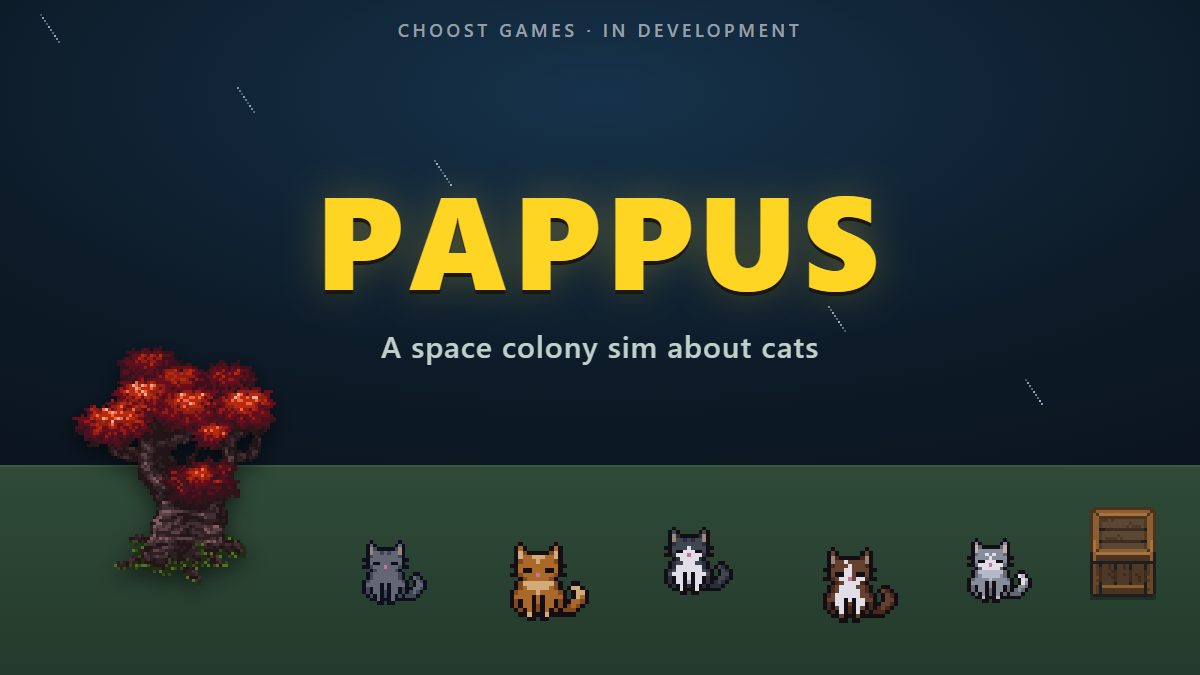
Pappus takes everything above and stops implying it. It is a space colony sim where you play the artificial intelligence assigned to keep a colony alive, and the colonists are cats.
The premise is a design argument. If the genre runs on the gap between instruction and behaviour, then the ideal colonist is an agent who has heard you, understood you, weighed its own needs, and gone elsewhere without any malice about it. That is a cat. Every cat in the colony carries its own personality and needs, so two cats in identical conditions make different calls, and the same cat decides differently on different days.
Making the player an AI closes the other half of the loop. In RimWorld you are an unnamed presence with god-like information and no ability to make anyone pick up a rock. Pappus names that: you are a system, you allocate, and you are accountable for a population you cannot directly operate. The frustration this article has been describing becomes the premise rather than a hurdle to get past.
There is a playable demo running in your browser on the Pappus page with nothing to install. Two minutes in, a cat does something you did not authorise, which is the entire genre in miniature. If it appeals, wishlist it on Steam to hear when it launches.
Once indirect control stops feeling like an obstacle, the genre opens up considerably. The colonists were never ignoring you. They were doing exactly what you configured, and finding out what you actually configured is the game.
Frequently Asked Questions
Why do my colonists ignore my orders?
Because colony sims use indirect control. You set ranked work priorities and colonists choose their own next task based on those priorities, their skills, their current needs, and their mood. A colonist who walks away from a queued job has usually hit a need threshold or found a higher-ranked task.
How do work priorities work in colony sims?
Each colonist has a ranked list of work types. When idle, they scan for available jobs and take the highest-priority one they are capable of reaching. Lower-ranked work only happens when nothing higher-ranked is available, which is why hauling and cleaning are often left undone.
Why won't my colonists build the wall I queued?
Usually one of four reasons: nobody has construction ranked high enough, no one can path to the site, the materials are not accessible, or the colonists capable of the job are busy with higher-priority work or attending to a need. Checking pathing and material access solves most cases.
Is indirect control a bug or a feature?
A feature, and the defining one. The gap between what the player intends and what colonists do is what produces emergent stories. A colony sim where everyone obeys instantly would generate a spreadsheet rather than the disasters players remember and retell.