
Is RimWorld Worth It in 2026? The Honest Answer Including the Price Problem
RimWorld is still worth buying in 2026 if you want deep emergent storytelling and can tolerate a 5 to 10 hour learning curve. The base game is the buy. The DLC pricing is the catch.
Yes, RimWorld is worth buying in 2026, with one caveat about pricing. The base game is around $35, holds an overwhelmingly positive Steam rating years after release, is still getting free updates, and delivers hundreds of hours without any expansions. The catch is that buying everything approaches $150, and nobody should do that on day one.
That is the verdict. Here is the reasoning, including the parts the enthusiastic recommendations tend to skip.
What is RimWorld actually about?
RimWorld is a sci-fi colony sim where survivors of a crashed spaceship build a settlement on a frontier planet. You control them indirectly through work priorities rather than direct orders, and an AI storyteller watches your colony's prosperity and paces disasters against it.
The storyteller is the design decision that made the game. Instead of random events, you get authored difficulty that responds to how well you are doing, which turns a management sim into something that produces narrative arcs on purpose. Randy Random, the chaos option, ignores that pacing entirely and is beloved for it.
Is RimWorld still worth it years after release?
Yes, and the staying power is unusual even by indie standards. The game sits at overwhelmingly positive on Steam across a very large review count, and it has held that rating for years rather than coasting on launch goodwill.
Development has not stopped either. Ludeon shipped update 1.6 alongside the Odyssey expansion in July 2025, and the pattern throughout the game's life has been that paid expansions arrive with substantial free updates to the base game attached. That matters for a purchase in 2026: you are buying something still being worked on rather than something preserved.
The mod library is the other half of the answer. The Steam Workshop holds many thousands of RimWorld mods, including total conversions, and it is the single biggest reason players report thousands of hours. When the vanilla game runs dry, the community has already built the version you were about to wish for.
How much does RimWorld cost in 2026?
| Item | Price | Released |
|---|---|---|
| Base game | ~$35 | October 2018 |
| Royalty | $19.99 | February 2020 |
| Ideology | $19.99 | July 2021 |
| Biotech | $24.99 | October 2022 |
| Anomaly | $24.99 | April 2024 |
| Odyssey | $24.99 | July 2025 |
Everything together lands near $150, which is genuinely a lot for an indie game and is the standing complaint in the community. The expansions rarely go on deep discount, so waiting for a sale helps less here than it does elsewhere.
Do you actually need the DLC?
No, and this is the part worth internalizing before you check out. The base game was the complete game for years and earned its reputation without any expansions attached. The DLC adds systems rather than filling holes.
The rough community consensus on ordering: Royalty, Ideology, and Biotech are the ones that deepen the core loop, with Biotech's children and mechanoid systems getting the most enthusiasm. Anomaly adds a horror layer with monoliths, fleshbeasts, and containment, which changes the tone of a run substantially. Odyssey adds the gravship, letting you build a mobile colony, relocate anywhere on the planet, and eventually reach space, and it reviewed extremely well at launch.
The sane path is to buy the base game, play a hundred hours, notice which direction you keep wishing the game went, and buy that one. Anyone telling a newcomer to buy the complete package is helping the wrong person.
How hard is RimWorld to learn?
Five to ten hours before the systems feel natural, which is moderate for the genre. The concepts that need to click are work priorities, storage logic, and the stabilise-then-expand rhythm that governs a good colony's growth.
Players coming from real-time strategy have the hardest time, because indirect control fights every instinct they have. A colonist who ignores an order is behaving correctly, and learning to debug that rather than fight it is the actual skill.
Compared to its famous sibling, it is dramatically friendlier. Our RimWorld vs Dwarf Fortress comparison covers that gap in detail, and if you want something gentler still, colony sims for beginners has better first steps.
What do you actually do in a run?
You start with three crash survivors and a map. You get food, shelter, and a bed running before the first raid, then you spend the next several dozen hours dealing with the consequences of every decision made in that first hour.
The systems that generate the stories are the human ones. Colonists form relationships, develop grudges, break down when their mood drops, and carry traits that make them irrationally good or catastrophically bad at specific things. The official pitch calls it a story generator rather than a colony sim, which is marketing that happens to be accurate. Every raid, thunderstorm, and passing trader is a card dealt into a narrative rather than a random roll.
Injury modeling is the other standout. Individual body parts get damaged, diseased, or removed, prosthetics range from a peg leg to bionics that make someone superhuman, and organs can be extracted, sold, and transplanted. The game does not comment on your choices there, which is its own kind of comment.
Who should skip RimWorld?
A few people genuinely should. If you want direct control over units, the indirect system will irritate you for the entire run rather than for the first hour. If you want a game with an ending, RimWorld technically has one and almost nobody plays for it. If you want visual polish, this is a game of small flat sprites and it has never pretended otherwise.
And if you specifically want to build a beautiful settlement without survival pressure, a city builder will serve you better. We break down that distinction in colony sim vs city builder.
How does it compare to the alternatives?
Against Dwarf Fortress, RimWorld is the accessible one and Dwarf Fortress is the deeper one, and the free classic build of Dwarf Fortress makes that comparison cheap to run yourself. Against Oxygen Not Included, RimWorld cares about people where ONI cares about thermodynamics, so the choice is really about whether you want drama or engineering.
Against the newer wave, RimWorld's advantages are maturity and mods. Games like Going Medieval and Timberborn are friendlier and in some ways more polished, and neither has eight years of community content behind it. That gap is the main reason RimWorld still sits at the centre of the genre in its ninth year on the market.
The one place it genuinely loses is presentation. Small flat sprites on a single plane is a look, and several newer colony sims are simply prettier to sit in front of for six hours.
What is the verdict?
Buy the base game. Skip the expansions until you know which one you want. Expect ten hours of confusion followed by a few hundred hours of the best emergent storytelling in games, and budget for the fact that your first colony will die in a way you will feel personally responsible for.
At around $35 for something that routinely produces two hundred hour playthroughs, the base game is one of the better value propositions on Steam. The complete-package pricing is a real criticism and worth being annoyed about. It just has very little to do with whether you should buy the game.
For the wider field, our best colony sim games roundup covers what else is worth your time, and games like RimWorld handles the direct alternatives.
If $150 of expansions sounds like a lot
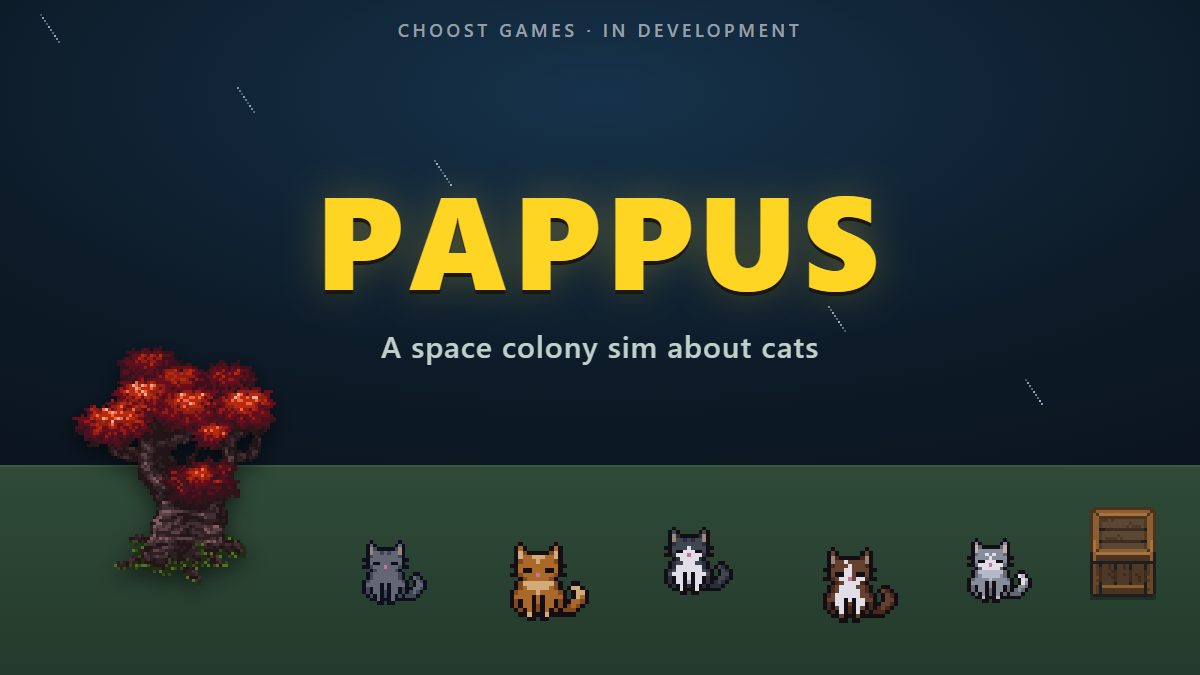
Pappus is a considerably smaller proposition pointed at the same appetite. It is a space colony sim where the colonists are cats and you play the AI assigned to keep them alive, built around the same core that makes RimWorld work: autonomous characters with needs and personalities, indirect control, and stories that assemble themselves out of systems rather than scripts.
The cats have their own personality axes and enough independence to make decisions you did not authorize, which is the RimWorld pawn relationship with the pretense removed. There is a playable demo on its page running in the browser with nothing to install, and it is a fair way to test whether the genre's core loop appeals before committing to a hundred and fifty dollars and a decade of somebody else's expansion schedule.
RimWorld remains the genre's reference point in 2026, and that is unlikely to change soon. Buy the base game, ignore the storefront's suggestions for a while, and let the first colony fail properly.
Frequently Asked Questions
Is RimWorld worth buying in 2026?
Yes, for players who want deep emergent storytelling and can accept a five to ten hour learning curve. It holds an overwhelmingly positive Steam rating years after release, is still actively developed, and the base game alone provides hundreds of hours without any expansions.
How much does RimWorld cost?
The base game runs around $35. Five expansions exist: Royalty and Ideology at $19.99 each, and Biotech, Anomaly, and Odyssey at $24.99 each. The complete package approaches $150, though the base game is designed to stand alone.
Do I need the RimWorld DLC?
No. The base game is complete and most veterans recommend playing a hundred hours before buying anything. Royalty, Ideology, and Biotech are the most commonly recommended first purchases. Anomaly and Odyssey change the game substantially and suit players who want a different experience rather than a deeper one.
Is RimWorld still being updated?
Yes. Ludeon Studios released update 1.6 alongside the Odyssey expansion in July 2025, and the base game has received free feature updates alongside every paid expansion since 2020.
How long does RimWorld take to learn?
Roughly five to ten hours before the systems feel natural. Work priorities, storage, and the stabilise-then-expand rhythm are the concepts that need to click. Players coming from real-time strategy usually take longer because indirect control fights their instincts.