
Whiskerwood vs Timberborn: Mice, Beavers, and Which Colony Actually Needs You
Timberborn is the finished one with water physics and vertical cities. Whiskerwood is the early access one with production chains and taxes. Here is which fits how you like to build.
Play Timberborn if you want a finished game about engineering your way out of environmental disaster. Play Whiskerwood if you want deep production chains and the anxiety of owing somebody a number. Timberborn is complete and polished. Whiskerwood is early access with its most interesting systems still ahead of it.
The two get compared constantly, and Kotaku's review of Whiskerwood <cite index="86-1">named Timberborn as one of its three reference points alongside Factorio and Sid Meier's Colonization.</cite> The comparison holds, and the differences underneath it are sharper than the cute-animals surface suggests.
What is the core difference between the two?
Where the pressure comes from. Timberborn threatens you with the environment, so it plays as an engineering problem. Whiskerwood threatens you with authority, so it plays as a throughput problem.
That single distinction explains almost everything else. Timberborn asks whether your dam will hold. Whiskerwood asks whether your supply chain will produce enough before the fleet arrives.
How do they compare feature by feature?
| Timberborn | Whiskerwood | |
|---|---|---|
| Developer | Mechanistry (Poland) | Minakata Dynamics, published by Hooded Horse |
| Status | 1.0, March 12 2026, feature complete | Early access since January 2026 |
| Setting | Post-human wasteland, beavers | Alternate 1700s islands, mice under cats |
| Core system | Physics-driven water and verticality | Production chains, 40+ commodities |
| Main threat | Droughts and toxic badtides | Escalating taxes, weather, pirates |
| Steam reception | 95% positive across roughly 37,000 reviews | 93% positive across roughly 1,493 reviews |
| Mods | Steam Workshop and map editor | Workshop present |
| Verticality | Central, build up on solid structures | Present, build up and dig down |
The review counts are not a quality signal so much as an age signal. Timberborn <cite index="87-1">gathered around 37,000 reviews at 95% positive within four days of its 1.0 launch,</cite> after five years of early access built the audience. Whiskerwood's <cite index="83-1">1,493 reviews at 93%</cite> come from a game six months old.
Which one is more finished?
Timberborn, without qualification. It <cite index="93-1">entered early access in September 2021 and reached full release on March 12, 2026,</cite> and Mechanistry has declared it feature complete. The 1.0 release added aquifers, geothermal fields, two selectable beaver factions, 17 built-in maps, and an in-game map editor.
Whiskerwood is six months into early access with its most thematically interesting layer unbuilt. <cite index="86-1">Plans to let a self-sufficient colony cut itself off from the Claws and revolt are currently the least developed part of the game, sitting mostly in the background as motivation to harvest more.</cite> That is a large asterisk on a game whose entire premise is oppression, and it is the main reason to wait if waiting appeals.
Which one is harder to learn?
Timberborn, though both are approachable by genre standards. Timberborn's difficulty is conceptual: water physics behave like water, so a dam that looks correct can flood your lower districts and a reservoir sized by eye will run dry in the third drought. Neowin's reviewer noted that <cite index="88-1">Mechanistry sent documents full of physics sandbox and advanced building information as part of the review package, and argued that material should be in the game as a wiki rather than living in community resources.</cite> A casual player expecting a cute beaver builder may bounce.
Whiskerwood is friendlier on the surface. Reviewers have singled out its interface, with one noting that <cite index="86-1">doing anything rarely takes more than two clicks and every menu is easy to read, navigate, and close, which is not always true in games like this.</cite> The complexity arrives later, through the commodity tree rather than through physics.
Which one has better building?
Timberborn for elegance, Whiskerwood for scale of the supply chain.
Timberborn's verticality is genuinely novel. <cite index="91-1">Ziplines and tubeways let beavers move across multi-level infrastructure, and cities grow in three dimensions rather than on a flat grid.</cite> Structures tagged as solid can be built on top of, which turns limited flat land into an architecture puzzle.
Whiskerwood also builds up and down, and the island constraint forces it, but the interesting decisions are in what you are building rather than where. Forty-plus commodities from raw resources to luxury goods like furniture and tea means the layout serves the production graph rather than the other way around.
Which one should you buy?
Buy Timberborn if you want to finish something. It is complete, heavily supported, priced around $34.99 with frequent discounts, and the water simulation is a genuinely distinctive piece of design that nothing else in the genre replicates.
Buy Whiskerwood if the colonial premise interests you more than the engineering, if forty-commodity logistics sound like a good time, and if you are comfortable buying into a game whose payoff is scheduled rather than shipped. At 93% across 1,493 reviews with reviewers already calling it one of the better city builders they have played, the risk is low and the ceiling is high.
Buy both eventually if the genre has you. They are close enough to compare and different enough that owning one does not spoil the other.
Which one will still be interesting in a year?
Whiskerwood, probably, and that is the argument for buying it now rather than later. Timberborn is finished, which is a virtue for a purchase today and a limit on what it becomes. Mechanistry has promised continued post-launch support and the game has mod support and a map editor, so the ceiling is community content rather than new systems.
Whiskerwood's ceiling is its own roadmap. The independence and revolt systems are the reason to care about the premise, and they have not shipped. If they land well, the game becomes something Timberborn is not trying to be. If they do not, you own a very good production-chain builder with a wasted hook.
Timberborn is the safer answer and Whiskerwood is the more interesting bet. Both are reasonable positions.
Are these colony sims or city builders?
Both sit on the seam, and Steam tags them as both. Neither gives you named individuals with moods, traits, and relationships the way RimWorld does, so by the strict definition they lean city builder with survival pressure bolted on. Our colony sim vs city builder guide explains why that distinction changes what a game feels like, and what is a colony sim covers the mechanics on the colony side.
If you want the pure colony sim end of the spectrum, where the settlers are individuals rather than workers, best colony sim games has the field. For more in Whiskerwood's specific shape, games like Whiskerwood covers the wider set.
Where the cats are the ones being managed
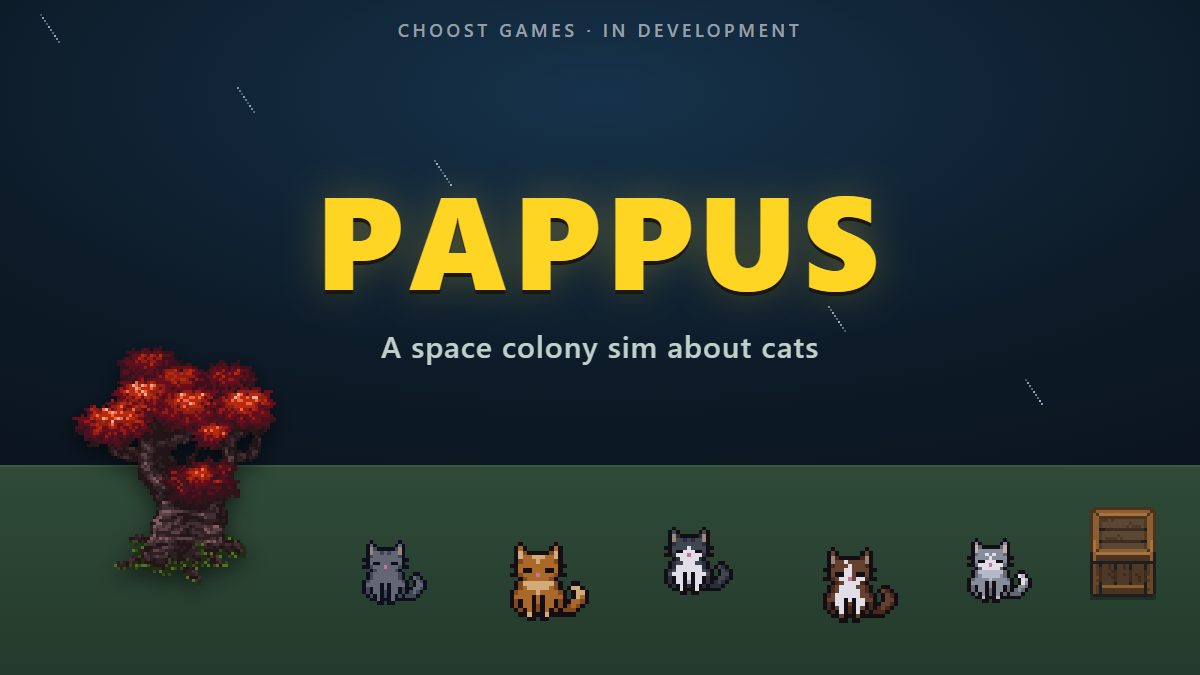
Pappus sits on the colony sim side of that line rather than the city builder side, which makes it a different proposition from either game here. You play the AI keeping a colony of cats alive on a distant world, and the cats are autonomous individuals with personalities and needs rather than workers who go where the logistics send them.
That means the failure mode is different. In Timberborn a drought kills your crops. In Whiskerwood a missed quota costs you standing. In Pappus a specific cat decides your plan does not apply to it, and the consequences propagate from there. There is a playable demo on its page, running in the browser with nothing to install.
Timberborn is the safer purchase today. Whiskerwood is the more interesting one to watch.
Frequently Asked Questions
Should I play Whiskerwood or Timberborn?
Play Timberborn if you want a finished game built around engineering puzzles and water physics. Play Whiskerwood if you want deep production chains and quota pressure, and you are comfortable with an early access game that is still adding its political systems.
Is Whiskerwood better than Timberborn?
Neither is clearly better. Timberborn reached version 1.0 in March 2026 and is feature complete with strong review scores. Whiskerwood entered early access in January 2026 with a Very Positive rating and a deeper logistics layer, but its revolt and independence systems are unfinished.
What is the main difference between Whiskerwood and Timberborn?
The pressure source. Timberborn threatens you with the environment through droughts and toxic badtides, making it an engineering game. Whiskerwood threatens you with authority through escalating taxes owed to cat overlords, making it a logistics and throughput game.
Are Whiskerwood and Timberborn colony sims or city builders?
Both sit on the seam. Steam tags both as colony sim and city builder. Neither gives you named individuals with moods and traits the way RimWorld does, so by the strictest definition both lean city builder with survival pressure attached.